21 grams
How Much Does a Soul Weigh?
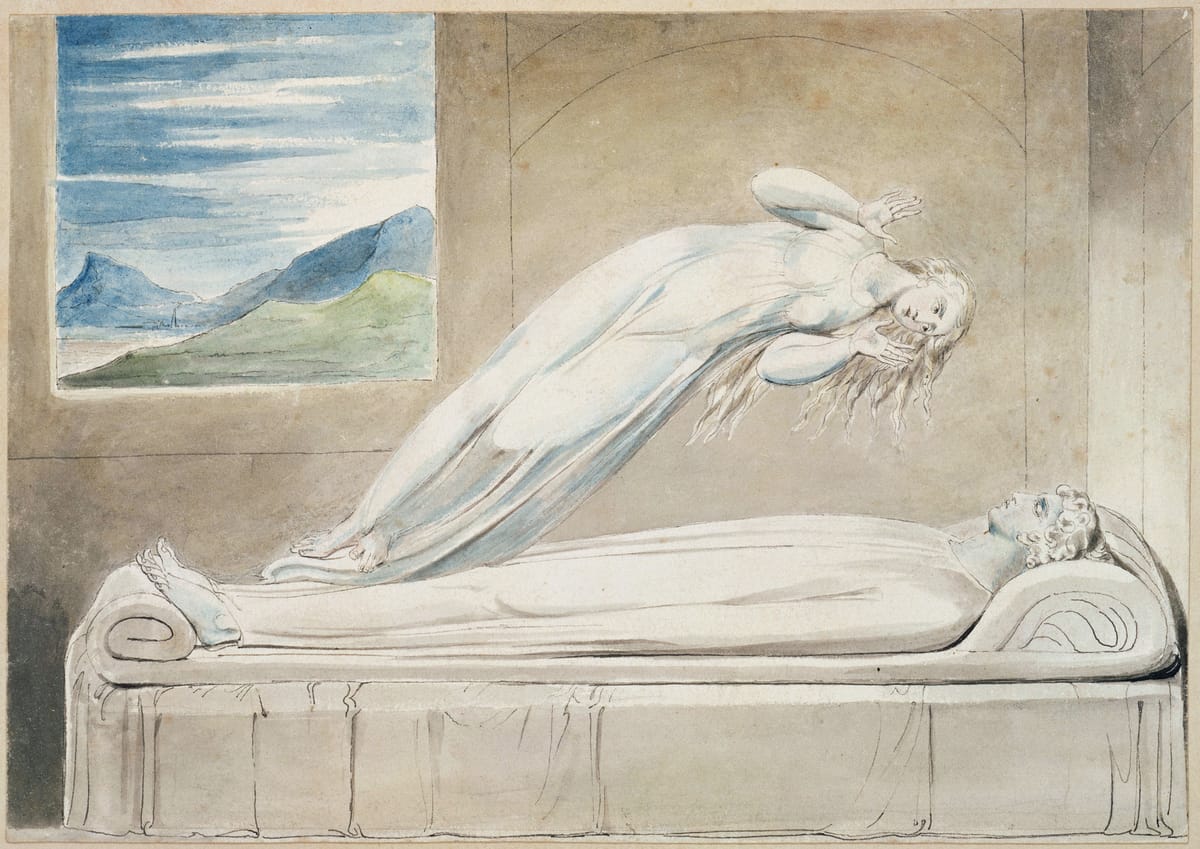
Let's forget for a moment that the evidence for a soul's existence is as substantial as that for Russell's teapot orbiting the sun in the asteroid belt. If a soul can "leave" the body, then presumably, while a person is alive, it is contained within their body. This raises a reasonable question: how much does it weigh?
Popular culture, from Iñárritu's film to Rosalía's recent album, knows the answer well: 21 grams. This figure isn't pulled out of thin air but originates from a "scientific" experiment.
Back in 1907, an American physician named Duncan MacDougall announced an experiment involving weighing dying patients. Precision scales placed under the beds of the dying reportedly showed, in at least one case, a loss of 21 grams shortly after death. MacDougall took this figure to be the mass of the human soul.
Naturally, such an experiment requires a control group. Driven by Christian superstitions about soulless animals, he sacrificed 15 healthy dogs on the altar of science and found no loss of mass in them.
Of course, subsequent attempts to replicate the experiment ended in complete failure, and MacDougall's own methodology cannot withstand any scrutiny. But perhaps modern science has something to say on the topic?
Let us reiterate: for the purpose of this article, we will assume the soul indeed exists. Since there is no specific organ where it could be contained, it's reasonable to suppose it represents an emergent property of a living person. In this sense, it appears akin to (or identical with) the mind or memory. Considering that souls, after mortal existence, supposedly either depart for a final destination—the choice of which is linked to one's deeds in life—or proceed to a new cycle of reincarnation, where the form again depends on life experience, we can say the soul contains the entirety of a person's life memory and, presumably, nothing more. (If the soul did not hold such memory, its punishment or reward would seem completely random, arbitrary, and immoral on the part of the higher beings orchestrating it all. We won't delve here into the debate about whether God could be malevolent.)
Thus, the soul, it appears, can be roughly described as information, the sum total of a person's memories of their actions, motives, and desires. Estimating the volume of human memory in familiar units is very difficult, with various authors providing figures differing by orders of magnitude. The upper boundary of these estimates sits around 1 petabyte.
20th-century science made two major discoveries that will be useful to us today. First, Einstein established the equivalence of mass and energy: E=mc². This principle, under which mass can convert to energy and vice versa under certain conditions, is the basis of atomic bombs and reactors, is well-established experimentally, and, to this day, cannot be seriously questioned.
Second, in 1961, Rolf Landauer formulated another equivalence principle—between energy and information. It can be understood as follows: erasing 1 bit of information transitions a storage device into a predetermined known state. In other words, regardless of whether that bit held a 0 or a 1, we write a 0. By erasing it, we have lowered the system's entropy. Entropy is, roughly speaking, a measure of a system's disorder. By transitioning the system from an unknown to a known state, we ordered it, thereby lowering its entropy.
The second law of thermodynamics, one of the fundamental physical laws governing nature, states that the entropy of a closed system cannot decrease. This law is largely responsible for the arrow of time, the aging of living beings, and the degradation of material objects. In our context, it means that although entropy decreased within the storage device, it must increase in the surrounding environment so that the total entropy of the universe does not decrease.
An increase in entropy means increased disorder or, put another way, a rise in temperature. Erasing a bit of information thus requires heating the environment, releasing energy. Consequently, Landauer argued, information and energy are equivalent. Although this principle clearly follows from our theoretical understanding of the universe, its experimental verification is challenging due to the extremely small amounts of energy involved. To date, Landauer's principle has been verified only in some specific systems.
Well, if energy is equivalent to both mass and information, then mass and information are also equivalent to each other. Using simple mathematics (which we'll omit here), we can estimate that 1 petabyte of information is equivalent to approximately 263 zeptograms of mass. In grams, that number looks like this:
0.000000000000000000263
Measuring a change in mass of a dying human with such precision currently seems impossible.



Comments ()