On (Super-)Intelligence
If Man is the King of Nature, who is the King of Kings?
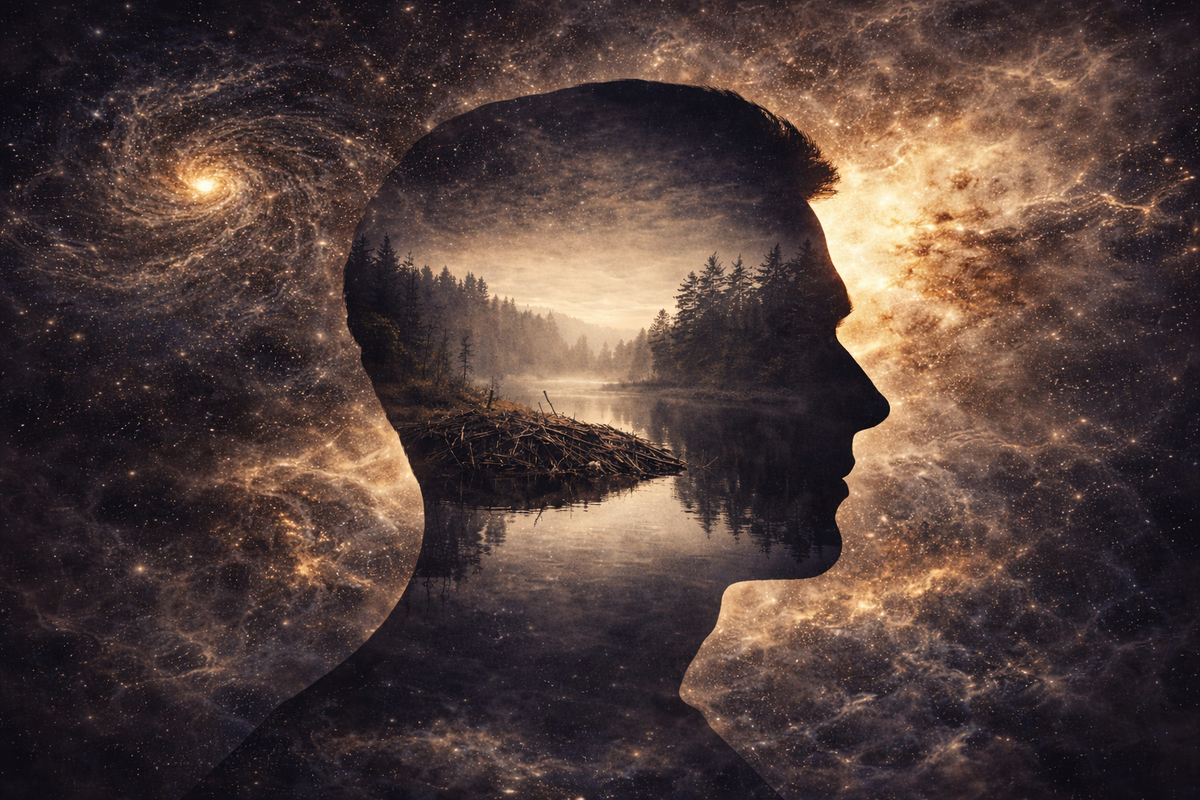
Man is the most intelligent creature on Earth, but science fiction writers and techno-optimists have long been concerned with the question: are beings with intelligence superior to humans, i.e. superintelligent, possible?
What intelligence actually is represents a separate, broad topic that we won't dive into here. For the purposes of this post, we'll assume that intelligence is the ability to solve complex problems through learning. Furthermore, we won't distinguish between the intelligence of individuals and that of an entire species, or between average and extreme values.
It's important to note that intelligence is an evolutionary adaptation. To some degree, many animals (and plants, and fungi) possess it, and it has developed multiple times, independently, across different branches of the tree of life. The purpose and function of intelligence lie in more successfully adapting to a changing environment. The degree of environmental variability Earth has experienced over the last couple of million years is, naturally, not particularly special. We can easily imagine worlds with both more stable conditions and those that change more rapidly.
Clearly, intelligence is a very "costly" adaptation. A developed brain consumes a significant share of an organism's resources (intelligence might, of course, have a material basis other than a brain, but the argument holds true in general terms) and requires forgoing other adaptations to the environment. Even if evolution randomly produces a being with high intelligence, whose capabilities exceed the necessary minimum, natural selection will favor sufficient intelligence, not the highest possible. From this, it's clear that in an environment more stable than contemporary Earth's, intelligence higher than that of humans cannot develop. Indirect confirmation of this is seen in animals inhabiting the ocean—objectively a more stable environment than land, even if it requires navigation in a more three-dimensional space. Neither dolphins nor octopuses can compete with humans in intellect.
As for an environment more variable than the one we're used to, in principle, it could give rise to more intelligent beings than humans. Two points should be made here. The first is that an excessively variable environment would create obstacles to its analysis and comprehension. In the extreme, variability implies the absence of constant physical laws altogether, which strips the concept of causality of meaning and makes not only intelligence, but probably life itself, impossible.
In less extreme conditions, one must compare the characteristic timescales of variability and learning. Obviously, if the rules of the game change faster than one can learn them, intelligence becomes pointless. Thus, while the emergence of a mind superior to the human one is possible, its characteristics cannot be boundlessly greater than our own.
The second point relates to the nature of human history. Even before the Neolithic Revolution and the transition to agriculture, humans had spread across all climate zones, universally occupying the top spot in the food pyramid, effectively becoming the "masters of nature." All of this required minimal technological progress and mostly occurred before the domestication of the first animals. Technological development is an optional bonus of intelligence, not a requirement for ecological dominance, as demonstrated by aforementioned dolphins.
The capacity for technological progress, it seems, is not directly linked to intelligence and is either an entirely independent evolutionary adaptation, or an unintended consequence of a combination of factors: possessing intelligence, a suitable environment, and the organism's prior physical adaptations. Be that as it may, this capacity has allowed humans to transition from simply dominating the planet to creating a largely (and, in the future, completely) artificial habitat, designed for their own convenience.
This environment is intentionally made stable, which, in principle, should lead to a decrease in intelligence over time due to the lack of necessity for it. An intelligent species could well evolve into something resembling beavers, which build their dwellings and maintain comfortable conditions inside them, thereby shielding themselves to some extent from the variability of the outside world. Anthropological data pointing to a decrease in human brain volume over the last 20,000 years could be interpreted along these lines.
The combination of human intelligence and the human capacity for technological development has proven sufficient for achieving an existence that is potentially entirely shielded from the environment. In this sense, humans are an absolutely successful species, evolving more towards simplification.
If human intelligence is sufficient to achieve this, then we shouldn't expect to find intelligence significantly higher than our own. On one hand, human intelligence is necessary for adapting to a variable natural environment; on the other, it's sufficient to begin creating a fully artificial one. Natural selection should "squeeze" intelligence into a narrow corridor where both of these conditions are met.
This conclusion shouldn't seem too extraordinary. Many parameters of living beings are confined within certain limits: they cannot be too small or too large, cannot be too fast, cannot have reaction times beyond a certain point, and have a limited range of perceivable electromagnetic waves.
Above, we discussed adaptation to the physical environment, but it's also possible that intelligence is simultaneously a necessary condition for, and an adaptation to, sociality. Building a society and navigating relationships with other people obviously requires high intelligence. Can the increasing complexity of the social environment drive a need for higher intelligence? Practice seems to suggest the opposite. More complex societies demand ever greater specialization from their members, and therefore lower the overall intelligence requirements for individuals. We leave final judgement on this issue open for now.
Let's return to the question posed at the beginning of this post: is the existence of superintelligence—intelligence significantly surpassing the human kind—possible? Despite everything said above—of course it is possible. One can envision at least four scenarios for this.
First, although natural selection pushes intelligence toward a certain level, at any given moment we might well discover creatures that have significantly deviated from this asymptotic level. Evolution can take millions of years to reach the optimal level of intelligence.
Second, up to this point we've assumed that only one intelligent species exists on a planet, which is certainly not a given. Human history includes long periods where several intelligent species coexisted. Since they all compete for the same ecological niche of "masters of nature," ultimately only one such species should remain. Although this struggle might (though not necessarily!) require an overdevelopment of intelligence, after one species wins, we return to the previously considered situation, where the level of intelligence is determined by the interplay between the natural and artificial environments.
Similar events could occur on a cosmic scale. If several "absolutely" successful species encounter each other, natural selection will, sooner or later, lead to one of them prevailing. However, during the interim period while the struggle lasts, superintelligence could potentially exist.
Third, super-intelligence could arise in a form that, for objective reasons, is incapable of technological development and building an artificial environment. Such beings would remain trapped on their home planets until discovered by friendly—or not so friendly—neighbors in space.
Fourth, an intelligent species might deliberately cultivate superintelligence for specific tasks. Practically, this could be implemented in various ways, from eugenics and genetic engineering on members of their own or another species, to the creation of intelligent machines. Crucially, this superintelligence could only exist within the hothouse conditions created by the intelligent species. Outside these conditions, natural selection would once again come into play, pushing it back toward the necessary minimum of intelligence. It could be compared to antibiotic-resistant bacteria which, when placed in an environment free of antibiotics, lose out to their non-resistant counterparts.
While we, as humans, might fear being destroyed by a superintelligent computer, we, as members of a community of intelligent species in the universe, have no reason for fear—either this computer would lose in a struggle with humans, or it would win and then simplify, becoming an ordinary intelligent species, or it would win and then go extinct, losing the evolutionary race to new intelligent species.
Comments ()