Wolfram and “ruleology”: when “simple rules” promise too much
and that’s exactly why it’s interesting!
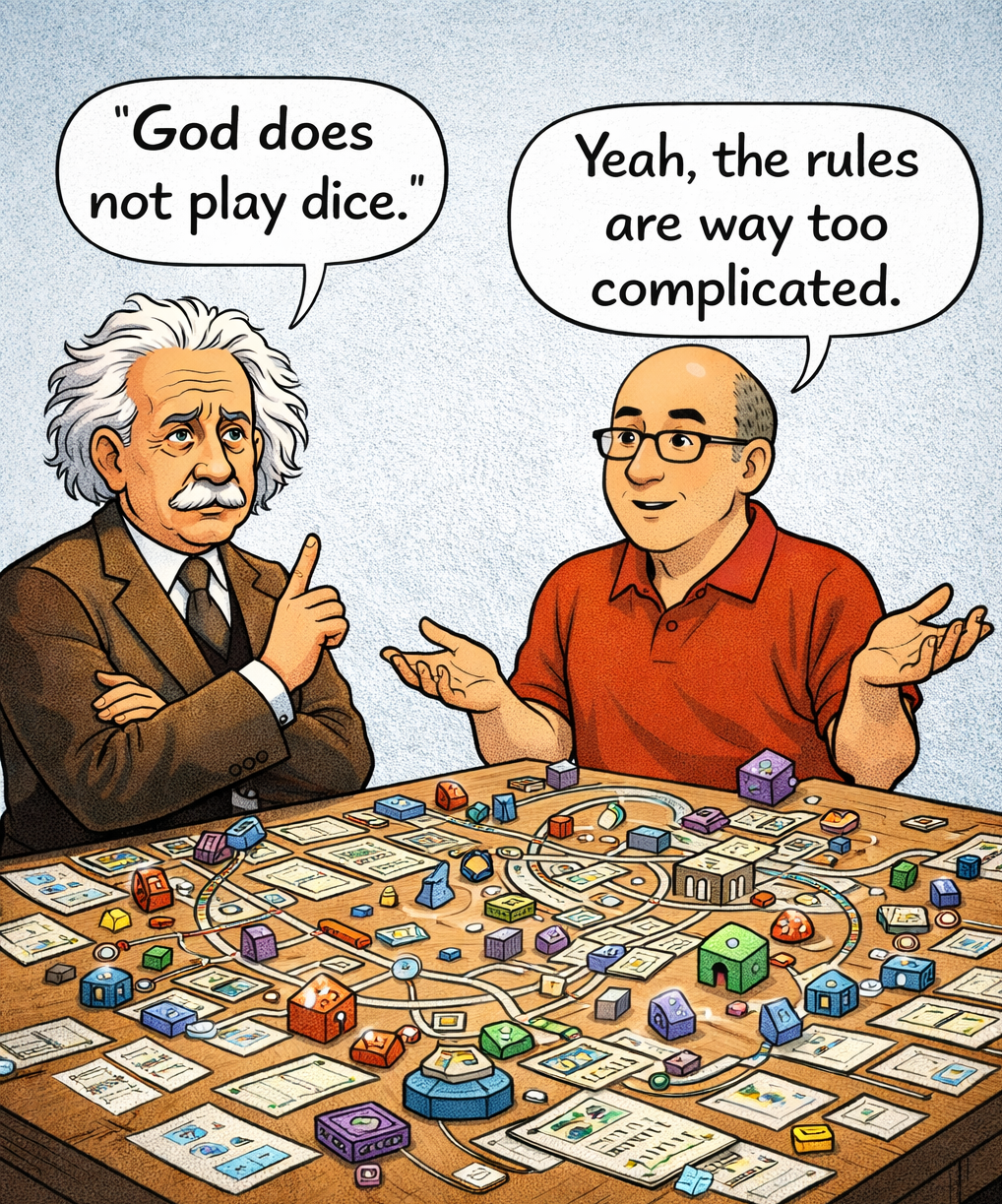
There’s a rare kind of scientist: not the one who merely publishes papers, but the one who changes people’s habits of thought. Stephen Wolfram is in that category. Even if you’re skeptical of his “theory of everything” ambitions, it’s hard not to acknowledge the scale of what he’s done: Wolfram Language / Mathematica is infrastructure that underpins modeling, computation, and teaching for a huge number of people.
That’s precisely why his “ruleology” (the idea that the bedrock of reality might be understood as a system of elementary rewriting rules) deserves discussion without patronizing smirks. This isn’t “just another fantasy.” It’s an attempt to say: maybe physics, at its deepest level, isn’t differential equations and smooth fields, but computation, and rules are the language the world is written in.
It sounds bold. And in places almost too beautiful. But let’s separate what’s strong here from what’s still a bottleneck.
Why it grabs you
Ruleology presses on a nerve of modern intuition: complexity can emerge from simplicity. We’ve seen it in cellular automata, fractals, networks. A tiny local instruction - and suddenly you get macroscopic behavior that looks “almost like life.”
In Wolfram’s hands that becomes a worldview:not “equations describe the world,” but “the world is a process that can be thought of as computation.”
There’s a genuine philosophical freshness in that, especially for anyone who’s tired of the feeling that fundamental physics has been circling the same boundaries for years (gravity, quantization, singularities, mismatched scales) as if it’s waiting for a new vocabulary.
But a question remains that aesthetics can’t cancel: “why?”
The skepticism here isn’t the cheap “sounds unlikely, therefore false.” It’s practical, almost engineering-minded.
Because we already have a language that works extraordinarily well: differential equations and everything around them — analytic methods, numerical solvers, approximations, asymptotics. This isn’t just tradition. It’s a way to compress the world into compact descriptions and get predictions you can actually test.
So the fair question to ruleology is:
What does it add on top of what we already know how to do?
- Does it produce new observable effects?
- Does it let us calculate things we couldn’t calculate before?
- Does it explain the origin of familiar physics not as metaphor, but as a procedure you can check?
If the answer is “it’s a different foundation, mainly because it’s prettier,” then it’s an important philosophy of computation — but not necessarily physics.
A tension hides here: simple rules vs. the complexity of search
Ruleology’s strongest rhetorical move is: “look, the rules are elementary.” And that can be true — the local step can be almost childlike.
But then comes what people usually tuck away under the word “exploration”: the space of rules is enormous. Many rules. Many combinations. Many initial conditions. Many notions of “closeness” to known physics.
And you end up with a near-paradox: the approach is sold as simple, but the investigation becomes a combinatorial marathon.
That’s not an accusation, but a point of strain. It shows up in any generative program: it’s easy to declare that reality is produced by simple building blocks; it’s hard to answer science’s core question:
Why these rules rather than others?
Without a strict selection criterion, you risk getting not a theory but a library of possible worlds where “you’ll find anything if you search long enough.”
But science isn’t a catalog of “what’s possible.” Science is the discipline of “what reality actually picked — and how to test it.”
“Computational irreducibility”: an honest idea and a dangerous excuse
Wolfram’s powerful claim is that many systems can’t be “compressed” into a closed-form prediction — to know what happens, you have to run the computation. That’s serious. It’s a reminder that demanding “give me an explicit formula” can sometimes be the wrong demand.
But the idea has a tempting shadow: it can turn into a universal answer to uncomfortable questions.Why no explicit derivations? — irreducibility.Why no compact checks? — irreducibility.
And that’s where a nearly theological tone can creep in: “the world is just like that, accept it.” At some point, “computational irreducibility” starts to function like a scientific version of “the ways of the Lord are inscrutable”.
It’s about the risk of an explanatory mode in which any demand for clarity gets deflected with something almost sacred.
How to read ruleology without cheapening either it or physics
The most productive stance is to treat ruleology not as “replacing all of science,” but as a candidate for a new fundamental language.
If that language can:
- reproduce known physics as an approximation,
- generate distinguishable effects,
- provide transparent criteria for choosing rules,
- and keep contact with measurement,
then it becomes more than a beautiful philosophy of computation — it becomes a real physical program.
If it can’t, it still has value as an intellectual provocation: a reminder that the world may be more discrete than we assume, and that “simple rules” can produce structures you can’t understand without computational experiment.
Bottom line
Wolfram is “deservedly important” not because he loudly says “theory of everything,” but because he has actually made computation a central way of thinking about mathematics and modeling.
Ruleology deserves respect in the same spirit: as a bold bet that the foundation might be computational.
But respecting an idea doesn’t mean exempting it from hard questions. If anything, the most respectful question to ruleology is simply this:
Where is the concrete advantage and how do “simple rules” avoid turning into “a complicated brute-force search through everything”?
Because if that question gets a clear answer, ruleology has a real chance of becoming not only a compelling picture, but a working theory.
Check our previous posts on cellular automata:
 Elizaveta Girshova
 Elizaveta Girshova
And on phenomenon of emergence:
Peter Konik Peter Konik
 Peter Konik



Comments ()